
The realization of the human according to Humberto Maturana’s theories
Introduction
At the beginning of a recent essay, philosopher Rosy Braidotti notes that we, people of the 21st century, are now placed in a decidedly post-human context, as demonstrated by the fact that, when interacting through our ubiquitous digital media, we are frequently asked to prove that we are not robots (2019). In the algorithmic culture with which we are now imbued, not only does the way we create and share meaning imply both human and algorithmic agency, but the very capacity for interaction and discourse has become characteristic of both people and machines. The use of human language and conversation, distinctive elements of Homo Sapiens, has extended to other strange, disembodied and automated entities, with which we are more or less subtly broadening our relational spectrum.
As always happens with innovations, this new way of life has sparked a conflicting debate, assessing its opportunities and risks for some aspect of human and social life. From this perspective, we find it positive to be forced to debate – from new angles – fundamental issues, forced, for example, to critically re-examine the challenges to the centrality of humanity in the world or the role and functions that language plays within it – including its new forms of relational hybridization – as our primary existential dimension.
All this, as noted by many, occurs against the backdrop of a great contradiction. As Homo sapiens, we are slipping into this new socio-technical and cultural stage – which seems so coveted, so eager is the pursuit of it – while simultaneously, in light of climate disasters and the voracious exploitation of raw materials, we risk losing our ancient and beneficial relationship with the other elements with which we share the common biosphere – on which, quite simply, our very life depends.
At this point – given the magnitude of these transformations and knowing that human history has been rooted and has continued on Earth through a dual matrix, biological and cultural – we believe it appropriate to contribute to the discussion by recalling theoretical approaches capable of placing the issues under discussion within a broader context. This can help us clarify the dynamics, specificities, and constraints inherent to the human race in light of its long adaptive journey, and acquire a more solid critical cognitive foundation for assessing the sustainability and human livability of social scenarios in which the role of technology is touted—often leaving us confused and uncertain – as the main solution.
Our starting point is that much has been done recently on the cultural front, specifically regarding the topic of “algorithmic culture,” especially in the field of so-called cultural studies. The aim of this paper is therefore to complement the conclusions drawn from this type of research with evidences from reflections that are more attentive to considering human events in light of our biological substratum – which is, so to speak, the design constraint of living systems.
Words/actions: in the networks of conversations originating algorithmic culture
The work of Ted Striphas, author of the research Algorithmic culture before the internet (2023), is one of the most important works recently carried out in the field of cultural studies regarding the new dynamics of intermediation offered to us by today’s digital platforms, here investigated for the deep origins they have in human history. Moreover, the work has the merit of incorporating many other research studies on the topic, both past and recent.
As is well known, in this type of study the authors devote an almost obsessive and meticulous attention to human language, to which they apply sophisticated methodological and intellectual work. For them this is clearly a necessary and instrumental attention, even considering the diversified and ramified developments that various human cultures, with their different symbolic systems, have developed over time – producing also large amount of documents – regarding the networks of conversations activated by people to address and shape the human events they try to reconstruct.
Anyone who has read the text will certainly have noticed how attention to language, starting with a focus on so-called keywords – treated as important indicators and delicate seismographs of social change – has proven to be a fundamental factor in the ability to critically interrogate our past.
The research has thus revealed how algorithmic culture has always been intertwined with the burdensome issues that human coexistence forces us to face, confronting us with questions relating to state policies, wars, imperialism, colonialism, totalitarianism, ideas of race, gender, sexuality, family, and normativity.
The splendid and technological world of networks and digital media – as demonstrated by Striphas and, I would say, unfortunately, all of today’s daily news – seems not to have freed us from this, nor has it even made the task easier. The same problems are inherent in the very genealogy of an algorithmic culture that has fueled, and for some still fuels, (naive) enthusiasm about the possibility of overcoming and even absorbing, thanks to it, harshness and injustices in human and social relationships.
Thus, for cultural studies researchers, language, in its forms and historicity, is the essential tool for re-immersing oneself in the flow of conversations held by people who, precisely through these networks of conversations, have acted on and determined the reality that precedes us, somehow constraining our present.
The author reminds us of this constantly, also recalling other intellectuals (Karl Marx: “People making history in circumstances … under conditions not of our own making”; Hans-George Gadamer: “When you take a word in your mouth, you have not taken up some arbitrary tool that can be thrown in a corner if it doesn’t do the job, but you are committed to a line of thought that comes from afar and reaches beyond you”) (Striphas 2023, p. 6, p. 228).
At the same time, by recognizing the structuring connections, the scholar encourages us to be proactive in building an alternative reality, a possibility that also passes through the use of our definitional agency to create new terms/concepts and thus make language more adherent to the desired social world – towards more acceptable ways of human coexistence – thus challenging those unwelcome powers that some cultural/algorithmic devices try to impose on us.
The truth is that language is inspiring and closely connected to the possibilities of human action as well as to the coordination of social behaviors, a fact we intuit but which can remain too implicit if approached only on a strictly cultural explanatory level.
Maturana and the biological and cultural matrix of human existence
Fortunately, we have access to other masterful and complementary insights into these issues, capable of making us reflect and further clarifying the potential and constraints of human existence in its relationships with the world and the people around us.
Humberto Maturana (1928- 2021) was a Chilean neurophysiologist and philosopher, renowned – along with his students, particularly Francisco Varela – for developing original systemic theories on the biological and cultural matrix of humanity, stimulating insights and developments in many other fields of knowledge: from biology to psychology, from sociology to organizational science, from computer science to cybernetics.
Given the breadth and depth of his work, some have spoken of a veritable cosmology (see Maturana, Verden-Zöller 2008), so it is imperative to refer to his works for a better and more complete understanding. For our part, we will attempt to briefly outline both the general framework and some elements regarding the realization of human existence in its biological and cultural developments.
Fortunately, we have access to other masterful and complementary insights into these issues, capable of making us reflect and further clarifying the potential and constraints of human existence in its relationships with the world and the people around us.
Humberto Maturana (1928- 2021) was a Chilean neurophysiologist and philosopher, renowned – along with his students, particularly Francisco Varela – for developing original systemic theories on the biological and cultural matrix of humanity, stimulating insights and developments in many other fields of knowledge: from biology to psychology, from sociology to organizational science, from computer science to cybernetics.
Given the breadth and depth of his work, some have spoken of a veritable cosmology (see Maturana, Verden-Zöller 2008), so it is imperative to refer to his works for a better and more complete understanding. For our part, we will attempt to briefly outline both the general framework and some elements regarding the realization of human existence in its biological and cultural developments.
A preface: Maturana explains his theories in a language that is at times quite difficult, as he tends to shift and maintain a continuous connection within his explanations between a whole network of ideas that sometimes reference each other in a circular and iterative manner – a fact due both to his discursive and terminological originality and to the complexity of the processes underway in the biosphere.
Fortunately, in his works he also provides ingenious and more intuitive graphic illustrations, which are a useful starting point for introducing some elements of his thought. Moreover, Maturana engaged in many open and public meetings to make his ideas more accessible, expounding on broad topics – education, ethics, politics – because he maintained that biology matters and is transversal to all human affairs.
Everything that happens to us passes through the structure and dynamics of our bodily constitution. Unlike machines, living beings are, in fact, peculiar, autonomous, and self-regenerating structures. We must be able to explain – and this is certainly a challenge to our imagination and explanation – their being, simultaneously, a process and a product of themselves.
The body allows us to do/know marvelous things, but alterations to its components or biological processes can suddenly impair our ability to know and speak. The fact is that our body – as we sometimes naively think or theorize – is not a limit; on the contrary, it is precisely this molecular structure that offers us that broad spectrum of possibilities for living.
Hence the importance of understanding its context and constitutive dynamics, especially for the purpose of evaluating the ways in which we know – and place ourselves within – so-called reality, about which we often claim certainties and unequivocal truths.
The limits of the culture of control
According to Maturana, one of the greatest limitations we face in understanding phenomena (historical, biological, human) is our cultural way of thinking, namely, thinking in local and linear causal terms. Living in a patriarchal culture, a culture centered on control, our usual argumentative form is linear causality, according to which “A” causes “B,” as if “A” alone determined “B.”
This cultural approach appeals to us because, when applied, it seems to offer infinite possibilities for the management and control of human life, including human relations with the biosphere. Causality thus becomes an a priori explanatory notion used by the observer to manage the regularities of the linear flow of their experiences.
However, this approach often makes us unaware that what we frame as a casual relationship is an abstraction of some local regularity of the structural dynamics of a system whose breadth we do not grasp, with the risk of not noticing the systemic structural coherences to which it belongs (see Maturana, Verden-Zöller 2008).
The antidote to the notion of causality is structural determinism. The biosphere is rich in entities that live in a flow of mutual and continuous co-adaptive interaction, and structural determinism is the awareness that the behaviors of all these composite entities, whether living systems or inanimate systems/objects, are entirely determined – both in their internal and relational dynamics – by their organization and structure (i.e., by the components of the unit and the relationships between these components). The notion of structural determinism is not so attractive in a patriarchal culture because its application requires sensitivity and awareness of systemic coherences, and therefore leads to cooperation, not domination and control. Furthermore, speaking of structural determinism does not mean limiting human life in its spiritual/psychic possibilities, since these depend, as we will see, on the development of its relational spaces and human coexistence (Ibid.).
System, structure, medium, interactions: logic and dynamics
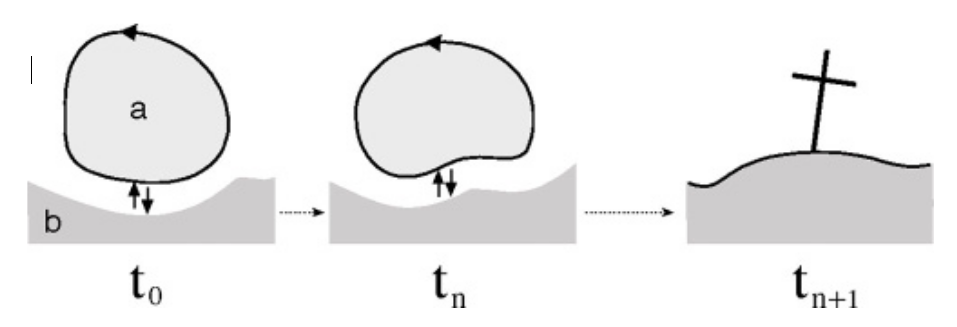
To introduce the elements of his theories, we will therefore begin with some simplistic illustrations devised by the author himself (ibid.). For Maturana (see figure 1), human beings are molecular systems (a) that have their own organization – which is expressed at any given moment in a specific structure – and are particular in that they are self-generating systems (also defined as autopoietic), therefore systems endowed with an organization capable of autonomously generating their own life. This is indicated in the figure by the arrow rotating around its shape, denoting its constitutive domain, or its physiological dynamics.
As an autopoietic system, the human organism has its own internal operational closure, meaning that possible changes in the components of its structure occur only on the basis of its own potential changes – consider the principle of structural determinism – that can therefore be stimulated – through the so-called perturbations – but not instructed by the external world.
The human living system is structurally coupled with another type of structure, a medium (b), namely the environment in which it lives, with which it establishes recursive interactions from the beginning of time until the end of its life. Maturana defines this coupling as ontogenetic structural drift that produces “a coherent history of congruent structural changes in both [structures]” (ibid.), as indicated by the mutual adaptation between the changing forms of these figures (a and b).
This process is configured as “history of changes courses in the conservation of both organization and adaptation in the living system until it dies at tn+1” (ibid.). Maturana further explains how the maintenance of this type of congruent co-evolution – that is, one capable of preserving the organizational and adaptive capacities of both structures – also includes the ways in which the two entities interact (our ways of reacting to/living in the environment).
All of this, combined, defines the hereditary characteristics of human beings in their specific generational lineage, passed down (phylogeny) through reproductive processes. These characteristics, therefore, are not determined by the inheritance of human genes alone, but by the entire course of co-evolutionary drift and its interactions.
In this sense, Maturana disagrees with those who, embracing Darwin’s concept, view the evolution of generational lineage in terms of the survival of the fittest, as if adaptation were a variable available to living beings with respect to a pre-existing medium.
Instead, their biological survival, due to the maintenance of their organizational and adaptive capacity, cannot exist without the maintenance of the same capacities by the host medium – with which they are, in fact, structurally coupled. In his words, “adaptation is not a variable; adaptation is a relation of operational congruence between the changing organism and the changing medium in which it lives.” (ibid.).
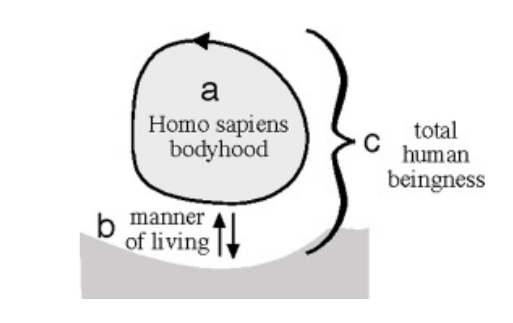
To sum up, Maturana (see fig. 2) tells us that we must conceive of human existence in its totality, that is, as including the corporality of a Homo Sapiens (a) who, through his lifestyle, continuously interacts – as structurally coupled – with his medium (b) in a reciprocal play of co-adaptation that must be congruent – that is, capable of preserving the organizational and adaptive abilities of both structures.
Obviously, if this does not occur, the ontological drift will stop, leading to the premature end of that living being. Furthermore, generational reproduction will incorporate and pass on the specificities – and organizational and adaptive abilities – of each particular lineage (Homo Sapiens + medium).
Personally, I find these explanations truly fascinating and effective in placing humanity in its proper place, far from a certain anthropocentric arrogance that tends to forget our dependencies and responsibilities as elements of a biosphere in which we exist alongside other life forms and entities, both organic and inorganic.
The social world: structural couplings and relational spaces between biological entities
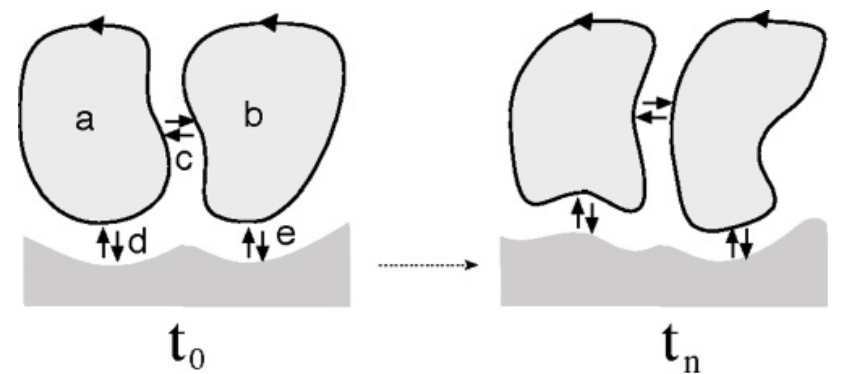
Maturana then integrates his vision into the social dimension (see fig. 3), introducing the elements of structural co-adaptation that occur in this context. Two human beings exist as biological entities in their corporality (a and b) and in the realization of their humanity in the relational space they establish between themselves (c), while obviously – as already seen – they also realize their humanity through recursive co-modulation with the rest of their mediums (d and e).
The scholar defines the interactions that occur in the relational space (c) as conversations, within which the component of languaging predominates, a term that suggests operating through language, one of our modes of action born in primordial times (ibid.). The other important component of conversations is emoting – the pulsating of emotions/feelings is another cornerstone of Maturana’s theories, which from a biological point of view frames emotions in terms of “dynamic bodily dispositions that define the distinct spheres of action within which we move. When we change emotion, we change our sphere of action” (Maturana, Davila 2006, p. 16).
At the origins of human language
To understand how, in the animal kingdom, language became a distinctive and fundamental element of human existence, we must return to primordial life contexts. According to Maturana, who draws on discoveries documented in the fossil record, we must go back at least three and a half million years.
At that time, bipedal primates existed, with upright postures and shoulders, but small brains (one-third the size of the current human brain). The social structure of these small groups was more or less the same as that of our own era – extended families of ten or twelve individuals, including infants, children, and adults, who ate primarily grains, being gatherers and only occasionally hunters.
For Maturana, “all this indicates that our ancestors shared food and were immersed in a recurring sensuality: males participated in the care of their children, in a way of life that establishes a lineage that extends to the present and in which the brain grows from about 430 cc to 1,450 or 1,500 cc.” (Ivi, p. 21).
Regarding the reasons for this growth, Maturana differs from other researchers who focus primarily on the instrumental and prehensile abilities of the hand, abilities he believes we share with other animals, and whose sensitivity is also attributable to the familiarity acquired in preparing food and in the gentle, sensual caresses and caresses applied to the surfaces of the body.
For the scholar, however, “the peculiarity of human beings lies not in manipulation, but rather in language and its connection to emotion” (ibid.). But if the hominization of the primate brain has something to do with language, Maturana asks, what does the origin of language have to do with it?
The premise is that in our ancestral lineage, a way of being together in small groups has been established, lastingly, in which the pleasure of physical closeness and collaboration is transmitted.
Language must have been born, from the beginning, intertwined with the emotions of coexistence, in the dynamic of recursive coordination of actions and emotions that today we call conversing. Speaking and conversing must have arisen together as a way of living together that integrates young and old, in a state of well-being, in the coordination of the acts of this coexistence, in the pleasure of sharing and participation (ibid., p. 8).
The primary dynamics of language, as we can observe in people conversing, is based on the ability to establish a course of interactions in which a flow of coordinated actions is formed,
if coordinated actions are not observed, or in modern parlance, if communication is not noticed, one cannot speak of language. Language has to do with coordinations of action, but not with any coordination of action, but with coordinations of consensual actions. Moreover, language is an operation in consensual coordinations of coordinations of consensual actions (ibid., p. 8).
Maturana, who is an admirer of matriarchal cultures, has no doubts in finding in the emotion of love – defined not in religious terms but as the full operation of mutual recognition and acceptance – the biological precondition that makes it possible to establish a history of recurring interactions sufficiently intimate to allow for that “recursion” in consensual behavioral coordination that constitutes language, and which is the foundation and prosperity of social relations.
The role of the observer and how human being arrive at knowledge
And here we must make a brief thematic digression on the role of the observer in Maturana’s theories, a digression that nevertheless remains entirely relevant and useful for our discursive purposes regarding the origin and “being” in language that human existence has become.
In his explanations, the scholar is very consequential: when he affirms and demonstrates – also through scientific experiments on the functioning of perceptual mechanisms, whose fallacies he also tests – that it is through the processual/biological dynamics of our body – and therefore through purely individual experiences – that we participate in the reality of the biosphere, he is forced to explain the ways in which we generally arrive at knowledge (see Maturana, Varela 1980).
We normally think of the world as an objective reality, “a truth whose validity is independent of us, because it does not depend on what we do.” We take many things and properties for granted, such as that of observation, but when we reflectively ask ourselves how this happens, what happens to living beings in knowing, “if we admit such questions we realize that we must propose an explanation of the phenomena of knowing and language as phenomena that involve us as living beings, because if we alter our biology, our knowing and our language are altered” (Maturana, Davile 2006, p. 49, p. 47).
The philosophical implications of different attitudes are significant: not asking these kinds of questions places us in a situation in which objectivity is not questioned, prone to think of a single possibility of a world – by allowing them, we open up the possibility of having multiple worlds (pluriverse).
So, despite our desire to be certain that we live in a world of perceptual solidity free of doubt, often ready to fall into the belief that things are only as we see them, without any alternative, the scientist makes us
acknowledge the fact that the states of neuronal activity triggered by different perturbations are determined, in each person, by their individual structure and not by the characteristics of the disturbing agent. This is true for visual experience, as for any other perceptual modality: in other words, we do not see the ‘space’ of the world but we experience our own visual field; we do not see the ‘colors’ of the world but we see our own chromatic space (Pasin 2004, p. 54).
For Maturana, the description of the phenomena we interact with – with entities of various types such as objects, relationships, processes, and so on – must therefore be read in terms of an “observer,” that is, any human being who is/operates in language by making distinctions.
Distinctions are operations performed in the domain of our experiences, even if they lead us to live/treat one of those experiences as something independent of us, even though, for example, its properties emerge from a background based on our distinction/action; or its dimensions emerge from the way we separate them from other entities, or from how we relate to or interact with them.
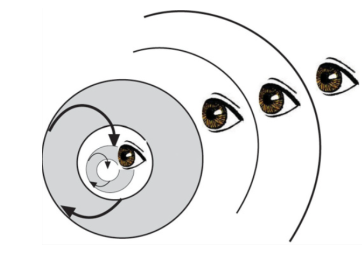
Here too, Maturana produces drawings (see fig. 4) in which he illustrates different types/levels of observational action: for example, that carried out by a living system which observes/distinguishes/describes its own generative domain (upper eye) or (lower eye) the resulting phenomenon in a different domain in which both the living system and its medium are observed/distinguished/described (see Maturana, Verden-Zöller 2008).
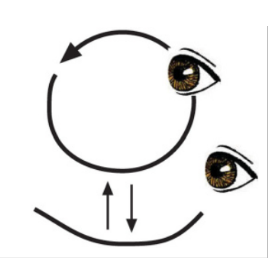
The ability to observe/distinguish/describe (process) generates a product (what is observed/described) that persists and which, in turn, can be the object of further reflection, upon which, recursively, another can be generated. Thus, there is the possibility of an infinite progression of reflections, each based on what preceded it (see fig. 5).
On the implications of linguistic dominance
Language, which constitutes the relational space, also leads us to the phenomenon of self-awareness – relating to oneself. Indeed, as Maturana explains, and as can also be intuited from the preceding drawings, it has to do with the process of reflection within the distinction of the one who distinguishes. More precisely, self-awareness arises when the observer constitutes self-observation as an entity, when, in using language, he distinguishes the distinction of distinctions.
Regarding the insistence with which language is described as a system of symbolic communication, Maturana is keen to highlight the secondary nature of this aspect.
The symbol is an indication within a field of concrete or abstract objects. But its constitution as an indicator of the indicated entity requires the operation of agreement, an operation that occurs when we are already in language. In fact, the semantic arbitrariness we have at our disposal in establishing the meanings of symbols in various languages derives precisely from the fact that, within linguistic communities, we must first agree (through consensual coordination operations) on the type of orienting interaction that the symbol will then activate.
However, we also, as external observers, view the domain of linguistic communicative behaviors as the domain of semantic behaviors, that is, we see only exchanges of meaning associated with linguistic expressions.
For Maturana, this depends on the fact that language is simultaneously finite and infinite, since every description can become the basis for new orienting interactions, and therefore new descriptions. In an infinite process of references, in so-called “descriptive recursion,” an observer external to the conversing subjects – and therefore unaware of their operational context – can fall into this kind of confusion.
Moreover, in a context in which language becomes an existential operator available daily, it will also be used to describe ourselves and our surroundings. It happens then, notes Maturana, that it is through this same descriptive recursion that we maintain our adaptation in the domain of language and our linguistic operational coherence – which we indicate as “I” (see Maturana, Varela 1992, p. 231).
Effectively, “from this process of recursive application of descriptions, self-consciousness emerges as a new phenomenon in a domain of self-description, with no other neurophysiological substrate than the neurophysiological substrate of orienting behavior itself” (Maturana, Varela 1980, p. 50). We therefore lose the sense of the agency of a corporeal self and are left with only orienting action which, in this recursive linguistic process, reflexively generates the illusion of an ego.
In short, to sum up, for Maturana, words represent actions – “everything said is said by someone” (Maturana, Varela 1992, p. 26) – which is why language is learned by living in coordinations of actions, with different domains of action implying different semantic domains, and vice versa.
In line with Striphas’s assertion, for Maturana too, living depends on conversing, and conversing on living. Furthermore, words are nodes in networks of coordination of actions that arise through coexistence, so changing the meanings of words implies changing the spheres of action, and changing the spheres of action implies changing the way of coexisting. Ultimately, if words are not changed, the actions they configure do not change, and the way of living does not change (see Maturana, Davila 2006, p. 106).
The problem of existing in conversational networks
From all this, we can see why Maturana was unscrupulous in addressing significant issues such as education, politics, society, and the law, recognizing them as themes that shape the foundations and conditions of human coexistence.
From this perspective, and on the value and care we should give to what we consider, in its various forms, culture, he offered us enlightening advice.
In reflecting on the transfer of human lineage from generation to generation, Maturana notes how cultural aspects impact its characteristics differently than biological ones, given their different ductility – cultural content/ways of life are already affirmed/modified during the apprenticeship of young people as they become adults. For the scholar, this poses a serious problem for human beings:
In our cultural evolution, we human beings can adopt and maintain any cultural way of life that does not eliminate adults before that way of life is learned by the young of the next generation. This is the main dilemma we are experiencing as humanity in our cultural evolution. It is indifferent to the biosphere, the earth, and the cosmos whether we live or not, whether the human lineage is preserved or not. At the same time, it is indifferent to the biosphere, the earth, and the cosmos which cultural lineage we live in, whether we live in love, collaboration, and well-being, or whether we live in submission, fear, or the interminable suffering of continuous cultural denial. It is to us human beings who cannot be indifferent whether we live and coexist in one way or another, because we exist in networks of conversations in which we can reflect and ask ourselves whether we like or dislike the coexistence we live (Maturana, Davila 2006, p. 9).
References
Braidotti, R., 2019, Posthuman knowledge, London, Polity press.
Maturana, H., Varela, F., 1980, Autopoiesis and cognition. The realization of the living, Dordrecht, Reidel publishing company.
Maturana, H., Varela, F., 1992, The tree of knowledge. The Biological Roots of Human Understanding, Boston, Shambhala publication, Inc.
Maturana, H., Davila, X., 2006, Emozioni e linguaggio in educazione e politica, Milano, Elèuthera.
Maturana, H., Verden-Zöller, G., 2008, The origin of humanness in the biology of love, Luton, Andrews UK Limited, versione digitale.
Pasin, M., 2004, Teoria della Conoscenza nella società Post-Fordista. Filosofia e Knowledge Management: un percorso concettuale, It Consult, approached on 03/01/2026.
Striphas, T., 2023, Algorithmic culture before the internet, New York, Columbia University press.
